 +91 9112515557
Measure accurately at home, convert between Indian and international sizing systems, and visit any jewellery store near you for a precise professional fitting — all in one guide.
Finger size is not a fixed number — it changes with temperature, time of day, season, and life stage. Getting it right before purchase means your ring is ready to wear the moment it reaches you, with no waiting and no adjustment needed.
In India, rings are sized using a numerical scale typically ranging from 5 to 30. Internationally, different systems are used — letters in the UK and Australia, decimal numbers in the US and Canada, and millimetre circumferences across Europe. This guide covers every system and shows you exactly how to convert between them.
The two measurements that matter are the inner circumference in millimetres (what you measure with a string or paper) and the inner diameter in millimetres (what you measure from an existing ring). Both lead directly to your Indian size.
If your measurement falls between two ring sizes, always choose the larger size. A slightly loose ring is far more comfortable and significantly easier to resize down than a ring that is too tight to remove safely.
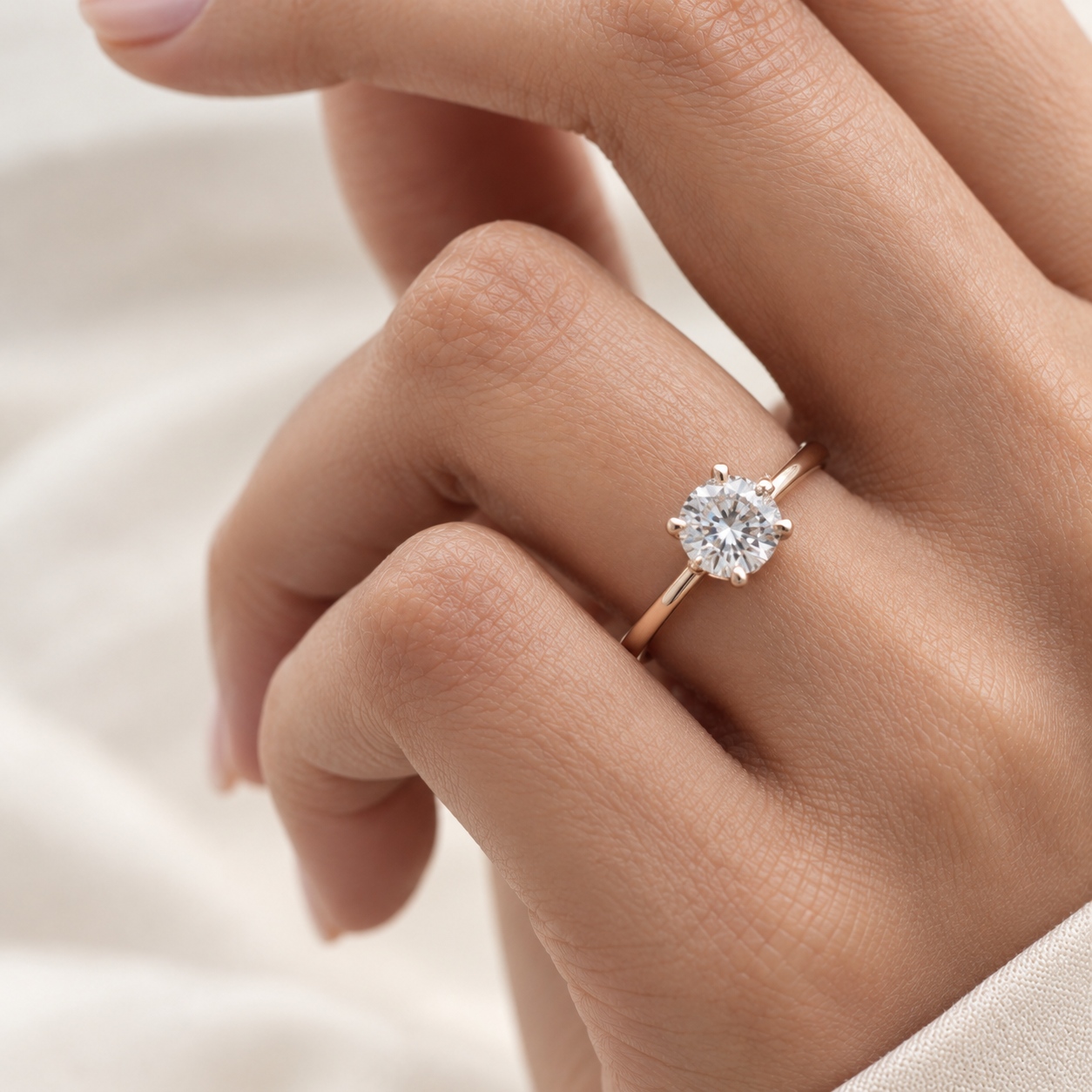
A perfectly fitted ring rests at the base of the finger — snug enough not to slip, free enough to slide over the knuckle.
Measure the finger you plan to wear the ring on. Sizes differ between hands and between individual fingers — never assume both hands are the same.
For the most precise result, visit any jewellery store near you for a professional fitting. When that is not possible, either of the two home methods below will give you a reliable, accurate measurement.
Use a thin piece of string, thread, or even a strip of paper. Wrap it around the base of the finger you want to measure. Mark the point where the string meets itself to complete a full circle, then lay it flat against a ruler and measure the length in millimetres. This is your circumference.
Match the circumference directly to the chart below. You can also divide by 3.14 to get the diameter if you prefer to cross-reference both columns.
→ Use the circumference column in the size chartTake a ring that already fits the intended finger comfortably. Place it flat on a ruler and measure the inner diameter — the straight-line distance across the inside of the ring, from inner edge to inner edge at its widest point.
Record this measurement in millimetres and match it to the diameter column in the size chart. This is the most accurate home method when you already have a well-fitting ring.
→ Use the diameter column in the size chartThe most accurate method, and always recommended for engagement rings or any significant purchase. Any trained jewellery professional can use calibrated metal ring mandrels to measure every finger precisely — accurate to within a quarter size.
Most jewellery stores offer ring sizing as a complimentary service with no purchase required. Walk in at any time during store hours.
→ Recommended for engagement rings & heirloom piecesCut a thin strip of string, thread, or paper — approximately 15 cm long
Wrap snugly — but not tightly — around the base of the finger you will wear the ring on
Mark or cut the point where the string meets itself to complete one full circle around the finger
Lay flat against a ruler. Measure in mm. Match to circumference column in the chart below.
If your measurement falls between two sizes, always choose the larger size. This applies to both the string method and the existing ring method. A ring that is slightly large can be resized; a ring that cannot pass over the knuckle cannot be worn at all.
Indian sizes 5 to 30, with precise circumference and diameter measurements and international equivalents across US/Canada, UK/Australia, and European standards. Common women's sizes (7–14) and men's sizes (16–22) are highlighted.
| India Size | Circumference (mm) | Diameter (mm) | US / Canada | UK / Australia | Europe (ISO) |
|---|---|---|---|---|---|
| 5 | 44.8 | 14.3 | 3¼ | F½ | 45 |
| 6 | 46.1 | 14.7 | 3¾ | G½ | 46 |
| 7 | 47.4 | 15.1 | 4¼ | H½ | 47 |
| 8 | 48.0 | 15.3 | 4½ | I | 48 |
| 9 | 48.7 | 15.5 | 4¾ | J | 49 |
| 10★ Peak | 49.9 | 15.9 | 5¼ | K | 50 |
| 11 | 51.2 | 16.3 | 5¾ | L | 51 |
| 12 | 51.8 | 16.5 | 6 | L½ | 52 |
| 13 | 53.1 | 16.9 | 6½ | M½ | 53 |
| 14 | 54.4 | 17.3 | 7 | N½ | 54 |
| 15 | 55.0 | 17.5 | 7¼ | O | 55 |
| 16 | 56.3 | 17.9 | 7¾ | P | 56 |
| 17 | 56.9 | 18.1 | 8 | P½ | 57 |
| 18 | 58.2 | 18.5 | 8½ | Q½ | 58 |
| 19★ Peak | 58.9 | 18.7 | 8¾ | R | 59 |
| 20 | 60.1 | 19.2 | 9¼ | S | 60 |
| 21 | 60.8 | 19.4 | 9½ | S½ | 61 |
| 22 | 62.1 | 19.8 | 10 | T½ | 62 |
| 23 | 62.7 | 20.0 | 10¼ | U | 63 |
| 24 | 64.0 | 20.4 | 10¾ | V | 64 |
| 25 | 64.6 | 20.6 | 11 | V½ | 65 |
| 26 | 65.9 | 21.0 | 11½ | W½ | 66 |
| 27 | 67.2 | 21.4 | 12 | X½ | 67 |
| 28 | 67.8 | 21.6 | 12¼ | Y | 68 |
| 29 | 69.1 | 22.0 | 12¾ | Z | 69 |
| 30 | 70.1 | 22.3 | 13 | Z½ | 70 |
Circumference and diameter data sourced from Indian industry standard references. Highlighted rows indicate the most commonly worn sizes. Size 10 is the most common women's ring size; Size 19 is the most common men's ring size across India. All measurements are in millimetres. Sizes may vary ±0.1 mm by manufacturer.
Diameter 15.1 mm to 17.3 mm. Equivalent to US 4¼ to 7. Indian size 10 (circumference 49.9 mm, diameter 15.9 mm) is the single most common women's size in India.
Diameter 17.9 mm to 19.8 mm. Equivalent to US 7¾ to 10. Indian size 19 (circumference 58.9 mm, diameter 18.7 mm) is the most common men's ring size across India.
Print this page at exactly 100% scale — do not scale to fit the page. Before measuring, verify the 100 mm reference bar below measures exactly 10 cm on your printed page. Place an existing ring over the circles and match the inner edge of the ring to the circle nearest in size.
◆ Print at 100% Scale Only — Do Not Scale to Fit ◆
Verify print scale: the bar below must measure exactly 100 mm / 10 cm when printed.
Finger size is not fixed — it changes throughout the day, across seasons, and with life events. These six tips ensure your measurement is as accurate as possible before you commit to a size.
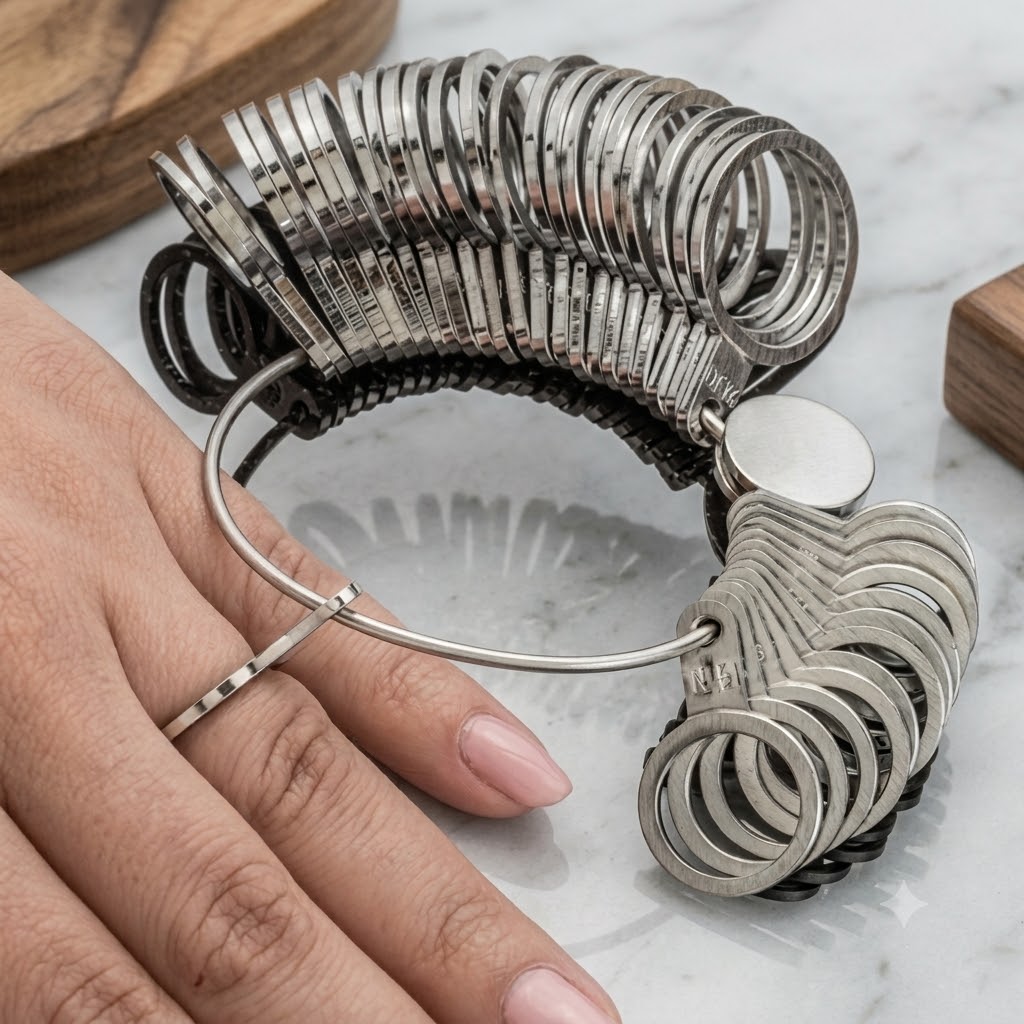
A professional ring sizer — the most accurate way to determine your size before purchasing.
Measure at end of day: Fingers are at their largest in the evening when warm. Avoid measuring first thing in the morning or in cold conditions — this will give an erroneously small result.
Measure 3 to 4 times: Take multiple readings throughout the day and use the average. This eliminates erroneous readings caused by temporary swelling or cold.
Measure the correct hand and finger: Your dominant hand is typically half a size larger than the other. Always measure the specific finger on the specific hand you plan to wear the ring on.
Account for knuckles: If your knuckle is significantly wider than the base of your finger, measure both and choose a size between the two readings. The ring must pass over the knuckle to be worn.
Account for band width: Wider bands (6 mm and above) fit tighter than narrow bands of the same nominal size. For wide bands, go up half a size from your measured size.
When in doubt, size up: A ring that is slightly large can be resized down. A ring that cannot be removed cannot be worn. Always round up when between sizes.
Fingers swell noticeably in heat and shrink in cold. Measure at room temperature — not straight after coming in from outside on a cold day or after a hot bath. Mid-afternoon on a normal day is ideal.
Fingers are measurably larger in summer and smaller in winter. If purchasing in winter for a summer occasion (or vice versa), allow for this seasonal variation. When unsure, always choose the slightly larger size.
Pregnancy, significant weight change, and certain medications all affect finger size permanently or temporarily. We recommend getting a fresh ring sizing at any jewellery store near you if you have experienced any of these recently.
Most fine jewellery rings can be resized. Understanding what is possible — and what is not — helps you purchase with full confidence, knowing your ring can be adjusted if needed after delivery.
Gold rings can typically be sized up by 1 to 2 sizes with no visible impact on appearance or structure.
The jeweller cuts the band, inserts a small piece of matching metal, then solders and finishes the joint seamlessly.
Rings with continuous engraving or channel-set stones along the full shank are more complex to size up.
Full eternity bands with stones all the way around the band cannot be traditionally sized. Sizing must be exact at purchase.
Sizing down is generally easier than sizing up. A small section of the shank is removed and the ends are rejoined.
Both gold and platinum rings can be sized down by 1 to 2 sizes with professional, seamless results.
Rings with stones set on the lower half of the shank need careful evaluation before resizing to ensure stone security is maintained.
More than 2 size changes in either direction risk structural weakness at the resized joint.
Tension settings — where the stone is held only by spring-metal pressure — must not be resized as this alters the tension securing the stone.
Professional resizing available for all rings purchased from Jhunjhunwala Diamonds, performed by our master goldsmiths.
All resizing uses matching metal from our inventory to ensure a seamless, invisible finish at the join.

You can find your nearest jewellery store to have your finger sized accurately by a trained professional using metal mandrels — a quick, complimentary service available at most jewellery stores.
