 +91 9112515557
Everything you need to select your diamond with confidence — from a step-by-step framework and practical buying tips, to the mistakes that cost buyers the most, and what it means to buy a conflict-free stone.
The sheer number of available options can feel overwhelming — particularly when every diamond appears similar to the untrained eye, yet the differences in quality and value can be significant. This guide gives you the framework, vocabulary, and watchpoints to buy with complete clarity and confidence.
A step-by-step process for narrowing from an ocean of options to the single diamond that fits your priorities and budget.
The most common and costly errors buyers make — from cut misrepresentation to misleading comparison techniques used in stores.
Understanding conflict diamonds, the Kimberley Process, and what it means when a diamond is certified conflict-free.
Every diamond search is different - shaped by personal taste, finger size, setting style, and budget. But the sequence of decisions that leads to the right diamond follows a consistent, logical order. Work through these steps and you will arrive at a diamond that balances quality and value precisely to your needs.
If the diamond is a gift, the recipient almost always has a shape preference — particularly for engagement rings. If you are unsure, a round brilliant is the safest choice. It offers more brilliance and scintillation than any other shape, suits virtually every setting style, and is never out of fashion.
Recipients of engagement diamonds tend to have clear expectations around size. If someone has their heart set on a one-carat diamond, even a beautifully cut 0.80ct will fall short. Establish the minimum weight before you look at anything else, and do not compromise on it first.
Begin with the highest quality diamond of your chosen shape and minimum carat weight. Then make concessions in a specific order to bring the diamond within budget.
Reduce clarity before touching colour or cut. Work down to VS2 before making any other concession — VS2 diamonds are eye-clean and represent outstanding value. Only move to the next step if VS2 is still above budget.
Once clarity has reached VS2, begin reducing colour. Work down to H before making any further concessions. H colour diamonds appear completely colourless to the naked eye once set and remain outstanding value in any metal type.
Cut is the most important quality factor and should be the last to be compromised. For round brilliants, do not go below Very Good. For fancy shapes, do not go below Good. A poorly cut diamond looks dull regardless of its colour and clarity — protect this grade above all others.
Concession Priority Order
If after following the steps above you are still outside your budget, repeat the process with new thresholds:
At this point, if you are still outside your budget, your next step will depend on your individual preferences and needs:
Each quality factor carries specific watchpoints that experienced buyers already know. These tips help you make smarter decisions — and avoid spending more than you need to for the same visual result.
Cut is the most important of the 4 C's. A well-cut diamond with modest colour (G-H) and clarity (SI1) will look more beautiful than a poorly cut D-Flawless stone.
For round brilliants, target Excellent or Very Good cut. For fancy shapes where GIA does not issue a cut grade, ensure Symmetry and Polish are both Very Good or Excellent.
Be cautious of sellers who assign their own cut grades in place of the GIA cut grade. This practice — known as cut inflation — is widespread and can misrepresent quality significantly.
When two diamonds share the same GIA cut grade, only then should you compare individual components like table %, depth %, culet, or girdle width as refinements.
Avoid deeply cut diamonds. These carry more of their carat weight hidden in the depth, meaning a 1.00ct deeply cut diamond may visually appear the size of a 0.90ct stone.
Never purchase a Poor cut diamond regardless of price. The trade-off is almost universally unsatisfying.
GIA Cut Grade — What Each Level Means
| GIA Grade | Visual Result | Recommendation |
|---|---|---|
| Excellent | Maximum brilliance, fire and scintillation. Top 3% of all cut diamonds. | First Choice |
| Very Good | Reflects nearly all light. Virtually indistinguishable from Excellent to most observers. | Recommended |
| Good | Reflects most light. Some brilliance sacrificed for size or price. | Acceptable |
| Fair | Allows significant light to escape. Noticeable reduction in sparkle. | Avoid if Possible |
| Poor | Most light escapes. Diamond appears lifeless and dull. | Avoid |
Girdle and Culet Guidance
Girdle: Avoid Extremely Thin girdles on rings — more susceptible to chipping. Very Thin girdles are especially risky on Princess cuts whose corners are already prone to damage. Acceptable for pendants and earrings.
Culet: Any culet graded Medium or smaller is invisible to the naked eye and has no negative impact on appearance.
The vast majority of people — including many gemologists — cannot distinguish a colour grade from the one immediately above or below without a direct side-by-side comparison in a controlled environment.
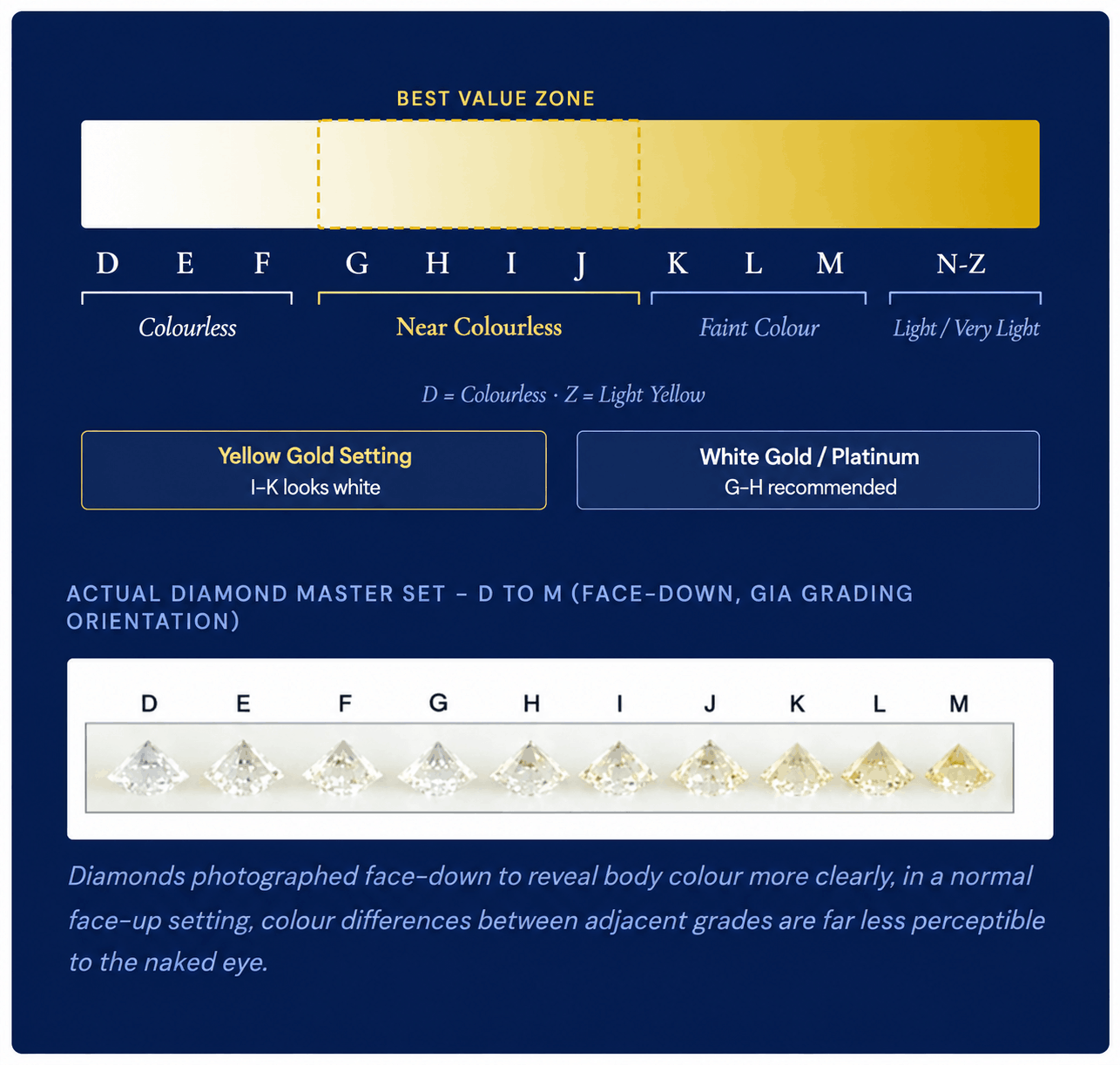
For the best value in white-appearing diamonds, target G-H in stones over 1 carat, and I-J in stones under 1 carat. Once set in a ring under normal lighting, these are indistinguishable from higher colour grades.
Yellow gold settings mask body colour effectively. If your setting is yellow gold, I-K colour represents excellent value and will appear white in the ring.
If a seller quotes a colour range (for example, "G-H colour") rather than a specific grade, the diamond is not GIA certified. Ranges are estimates only.
Brilliant cuts (round, princess, oval, cushion) hide colour better than step cuts (emerald, Asscher). Consider this if colour is a concern.
Colour vs Metal Setting Guide
For diamonds over 2 carats, VS2 or higher is safest — larger stones show inclusions more readily.
For diamonds between 1 and 2 carats, SI1 will have no inclusions visible to the naked eye in the vast majority of cases.
For diamonds under 1 carat, clarity is the least important of the 4 C's. SI2 is frequently acceptable and represents outstanding value.
VS1–VS2 is the most popular range among buyers: eye-clean in all circumstances, at a significant discount to Flawless or Internally Flawless.
Step cuts (emerald, Asscher) show inclusions more clearly than brilliant cuts. If purchasing a step cut, move up one clarity grade from your usual target.
If a seller gives a clarity range (e.g. "SI1–SI2") rather than a specific grade, the diamond is not GIA certified and the grade is an estimate only.
Clarity by Carat Weight — Recommended Minimum
| Diamond Size | Recommended Minimum | Notes |
|---|---|---|
| Under 1ct | SI1 (SI2 acceptable) | Inclusions rarely visible. Clarity least critical factor at this size. |
| 1.00 – 2.00ct | SI1 | Eye-clean in most cases. Evaluate SI2 stones individually before rejecting. |
| Over 2ct | VS2 or higher | Inclusions become significantly more visible at this scale. |
| Step cuts (any size) | One grade above standard | Emerald and Asscher cuts offer less inclusion-hiding ability than brilliant cuts. |
If buying as a gift, defer shape choice to the recipient wherever possible — it is the most personal preference and the hardest to change later.
Round brilliant diamonds offer the most brilliance and scintillation of any shape and suit virtually every setting. If in doubt, choose round.
Elongated shapes — marquise, oval, pear — appear larger face-up than round diamonds of the same carat weight. An excellent option when size is the primary priority on a budget.
The length-to-width ratio has a major visual impact on fancy shapes. A 1.30 oval looks very different from a 1.60 oval. When comparing diamonds of the same shape, stay within roughly 10% of your preferred ratio.
Oval L/W Ratio — Visual Comparison
The same carat weight oval looks dramatically different at L/W 1.10 vs 1.60. Focus your search within 10% of your ideal ratio.
Purchase diamonds just below popular "magic weights" — 0.90ct instead of 1.00ct, 1.40ct instead of 1.50ct. The price difference can be meaningful, but the visual difference is almost undetectable.
A 10% difference in carat weight between two well-cut diamonds of the same shape is very difficult to distinguish with the naked eye.
The most sought-after weights for engagement diamonds fall between one and two carats. If budget requires going below 0.75ct, a marquise or oval cut will appear larger than a round of the same weight.
Always ask for the exact decimal carat weight. Unverified descriptions like "approximately 3/4 carat" may be rounding a 0.65ct stone upward.
Price Premium at "Magic Weights"
Many buyers spend weeks researching diamonds but still make avoidable mistakes at the point of purchase. These are the most significant errors — and what to do instead.
Unlike colour and clarity, cut grade terminology is not standardised across the industry. One retailer's "Excellent" may be another's "Ideal" or "Signature Ideal." A seller may assign any cut grade they choose, based on any criteria they wish. Always verify the GIA cut grade directly from the GIA certificate — do not accept a retailer's proprietary grading.
A deeply cut diamond carries much of its carat weight hidden in its depth rather than its width. The diamond appears smaller face-up than a well-cut stone of the same carat weight — yet costs nearly as much. This is common in traditional jewellery stores because poorly cut stones cost less to source. A 1.00ct deeply cut diamond may visually appear to be 0.85ct.
Most buyers focus exclusively on the 4 C's — Cut, Colour, Clarity, and Carat — without realising that fluorescence is a fifth factor that can meaningfully affect a diamond's appearance and market value. A diamond with strong blue fluorescence may appear hazy or oily in natural light, while in D–H colour stones it can actually suppress perceived colour. Fluorescence is disclosed on every GIA certificate and should always be reviewed before purchase.
FTC guidelines permit a seller's stated colour or clarity grade to differ by one grade from an independent appraisal without legal recourse. A jeweller who believes a diamond is G colour is free to represent it as F. This leeway is actively exploited. Unless the diamond has a GIA certificate, do not accept any colour or clarity grade as reliable for a centre diamond.
Jewellery store lighting is specifically designed to make diamonds appear at their most brilliant. Lights calibrated towards blue wavelengths make yellower diamonds appear whiter. Before making a final decision, ask to view the diamond outside the spotlight area — by a window, in natural daylight, or under standard office lighting. This is the light your diamond will live in.
Approximately one-third of all diamonds in circulation have been treated in some form — laser drilling, fracture filling, or high-pressure high-temperature (HPHT) treatment. Treatments improve appearance but significantly reduce value and may affect the stability of the stone over time. GIA certificates prominently disclose any treatment. Diamonds without reputable certification may conceal this entirely.
Several common techniques used in physical stores can mislead buyers during colour comparisons. Knowing what to look for protects your decision-making.
Comparing different shapes: Body colour appears more prominently in some cuts than others. Comparing an H emerald cut against a G round will show a more dramatic colour difference than comparing two rounds. Always compare like shapes.
Comparing different cut qualities: A well-cut G diamond appears brighter and therefore whiter than a poorly cut G. If cut quality differs between the two diamonds being compared, any colour difference is exaggerated or distorted.
Uncertified comparison stones: If you cannot verify that both diamonds in a comparison have GIA certificates, the colour grades being cited have no objective basis. Never make a quality decision without seeing the actual certificates.
Being shown the best of limited stock: A traditional jewellery store typically carries a fraction of the selection available elsewhere. Being shown the "best" option available does not mean it is a well-cut diamond — only that it is the best of what that store currently holds.
If you need to leave your diamond with a jeweller for setting, cleaning, or repair, take these precautions against the remote possibility of a switch:
Note your diamond's GIA laser inscription number and location. Inform the jeweller you are aware of it — this alone removes significant temptation.
Before leaving the diamond, ask the jeweller to show you its inclusions under a loupe. Compare against your GIA certificate's diamond plot. You will be able to identify the stone with certainty when it returns.
For very high-value diamonds, have the stone independently appraised in writing before any third party takes possession, and re-appraised immediately upon return.
A grading certificate is not just a piece of paper — it is a permanent, independently verified record of your diamond's exact quality. Understanding what it means, and which laboratories issue reliable certificates, is essential to any diamond purchase.
Only a certificate from a reputable, independent laboratory provides an objective and standardised quality assessment. Retailer-issued grades or verbal assurances carry no independent verification.
A GIA certificate includes a unique certificate number that is laser-inscribed on the diamond's girdle and permanently on file with GIA. It can be replaced if lost or destroyed at any time.
Never confuse "GIA certified" with "certified by a GIA-trained gemologist." The former means the diamond was independently graded at a GIA facility. The latter means a store employee who attended GIA training graded the stone — an entirely different level of reliability.
Keep your certificate in a secure location, separate from the diamond. In the event of loss, insurance claim, or resale, the certificate is your primary means of establishing the diamond's identity and value.
Do not purchase any loose diamond over a meaningful value without a certificate from a reputable laboratory.
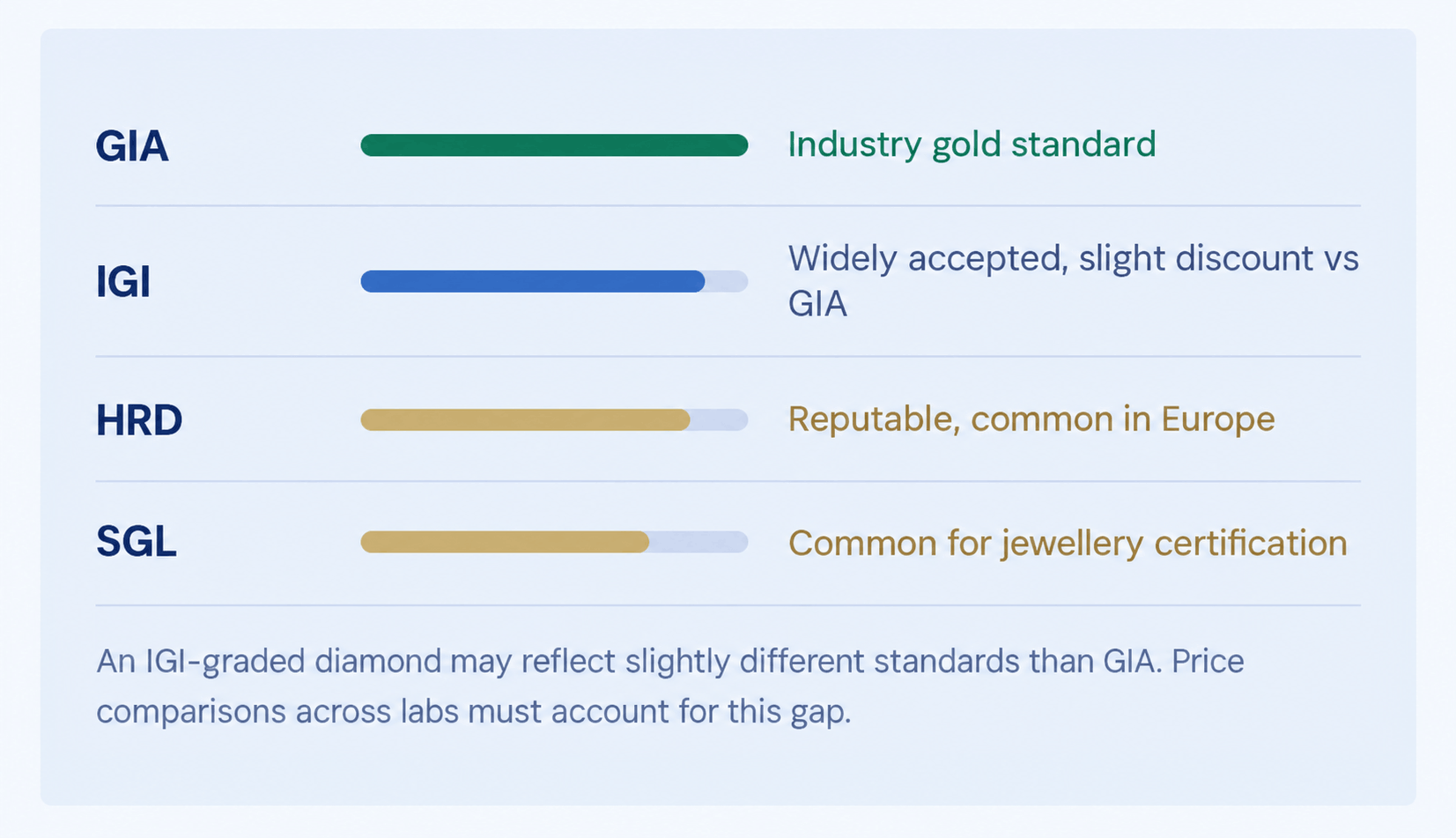
Not all grading laboratories apply the same standards. The bar chart below indicates relative grading rigour, with higher scores reflecting stricter, more consistent standards.
Ask for an internationally recognised laboratory certificate — such as GIA, IGI, or HRD — before committing to any significant purchase
Verify the certificate number matches the laser inscription on the girdle
Store your certificate securely and separately from the diamond itself
Check whether your certificate includes a diamond plot (full GIA Report) or only a summary (GIA Dossier)
Use the GIA's online verification tool to confirm a certificate's authenticity before purchase
Accept a retailer's own grading certificate as a substitute for GIA
Assume "GIA trained" means "GIA certified" — they are fundamentally different
Compare prices between a GIA-certified diamond and one certified by IGI or SGL without adjusting for potential grading differences
Purchase a diamond with a clarity or colour range (e.g. "SI1-SI2") — ranges confirm the absence of a lab certificate
Leave a diamond with any third party without first noting the GIA inscription number
Buying a diamond carries a responsibility that extends beyond quality and beauty. Understanding where your diamond comes from — and how the global industry works to ensure it was mined ethically — is an important part of being an informed buyer.
Conflict diamonds — sometimes called blood diamonds — are diamonds originating from territories controlled by armed forces or factions in opposition to internationally recognised governments. Historically, these diamonds were used to finance civil wars, rebel uprisings, and campaigns of violence that caused enormous human suffering.
In the 1990s, conflict diamonds accounted for approximately 15% of all diamonds sold globally. Largely in response to global pressure and the exposure of diamond-funded conflicts in Sierra Leone, Angola, and the Democratic Republic of Congo, the international diamond community came together to address the issue systematically.
Today, following the implementation of the Kimberley Process Certification Scheme, conflict diamonds represent less than one-tenth of one percent of the global diamond trade — a reduction of more than 99% in real terms.
Conflict Diamonds as % of Global Trade
The Kimberley Process Certification Scheme (KPCS) was launched in 2003 as an international initiative to prevent conflict diamond proceeds from financing armed conflict. Today, 80 participating countries agree to trade rough diamonds only with other KPCS members, creating a closed and audited global supply chain.
The scheme requires that every parcel of rough diamonds imported or exported be accompanied by a tamper-resistant Kimberley Process certificate. Any parcel arriving without certification is prohibited from entering the market.
Every rough diamond import and export must be registered with national customs authorities and accompanied by a sealed, certified parcel.
Trade is permitted only between the 80+ participating countries. Non-participating countries are effectively excluded from the legitimate global diamond market.
All importers and exporters must retain Kimberley Process certificates for a minimum of five years and file annual declarations of all import and export activity.
The result is that diamonds are now among the most monitored and documented natural resources in the world — more traceable than many agricultural commodities.
The Kimberley Process has not only reduced conflict diamonds — it has increased the flow of legitimate diamonds from developing nations that might previously have been overlooked in the global trade.
65% of the world's diamonds originate from Africa, generating approximately $8.5 billion annually for these economies.
Diamond revenues enable every child in Botswana to receive a free education. Since discovery, the country's secondary schools have increased 100-fold.
Approximately 40% of Namibia's export earnings come from diamonds, funding critical healthcare programmes including HIV/AIDS treatment.
Every diamond at Jhunjhunwala Diamonds is a 100% natural, conflict-free stone ethically sourced from the world's finest and most reputable diamond mines. We stand behind every stone in our collection with absolute confidence in its provenance, integrity, and beauty.
Jhunjhunwala Diamonds · 100% Natural Conflict-Free DiamondsShape and Minimum Carat: Confirm both before evaluating anything else. These are the non-negotiables.
Prioritise Cut: Never reduce cut quality before clarity or colour. An Excellent or Very Good cut is non-negotiable.
Verify the Certificate: Always ask for the grading certificate before purchase. Confirm the certificate number matches the diamond.
Shop Below Magic Weights: A 0.92ct and a 1.00ct look identical. The price difference is real.
Check for Treatment Disclosure: Any GIA-certified diamond will disclose treatments. Without certification, you cannot know.
Know Your Stone's Origin: Every Jhunjhunwala diamond is a 100% natural stone, ethically sourced from the world's finest mines — backed by our absolute confidence in its provenance and integrity.
