 +91 9112515557
Forged by the earth over billions of years. Carried to the surface by ancient volcanic forces. Cut and polished by the most skilled hands in the world. A natural diamond is not simply a gemstone — it is one of nature's most extraordinary achievements.
\Natural diamonds have been prized throughout human history for their brilliance, rarity, and extraordinary emotional resonance. They are the oldest objects most people will ever hold — genuine pieces of the ancient earth, formed long before life as we know it existed.
Only a finite number of natural diamonds exist on earth. Every one mined is one of a kind — no two natural diamonds are identical in character or formation.
For centuries, natural diamonds have symbolised devotion, commitment, and endurance. The word diamond itself derives from the Greek "adamas" — meaning unbreakable and unconquerable.
Natural diamonds formed between one and three billion years ago — predating almost all life on earth. The stone on your finger is older than most mountains, oceans, and continents.
A natural diamond is a mineral composed almost entirely of carbon atoms arranged in a crystal structure known as diamond cubic — the same element that forms graphite and coal, but in an arrangement so perfectly ordered that it becomes the hardest known natural substance on Earth, rating 10 on the Mohs hardness scale.
Diamonds are the only gemstone composed of a single element. This pure carbon lattice is what gives a diamond its extraordinary physical properties — its unmatched hardness, its unique refractive index of 2.417, and its ability to disperse white light into all the colours of the spectrum in a way no other gemstone can replicate.
Trace amounts of nitrogen, boron, or hydrogen sometimes enter the crystal structure during formation, influencing a diamond's colour, fluorescence, and character. These minute natural variations are part of what makes each stone entirely unique — a fingerprint of the conditions deep within the earth at the moment of its birth.
Key Physical Properties of a Natural Diamond
The maximum rating on the universal mineral hardness scale. No natural substance is harder.
Light bends dramatically as it enters a diamond, producing its characteristic fire and brilliance.
The only gemstone composed of a single element — carbon atoms bonded in perfect cubic symmetry.
Diamond conducts heat better than any other gemstone — a tactile quality that makes natural diamonds feel cool to the touch.
Every natural diamond is a testament to the earth's most violent and creative forces. Their formation is not a laboratory process or a manufacturing sequence — it is a geological event of extraordinary scale, driven by pressure and heat no human technology can truly replicate.
Natural diamonds were forged between one and three billion years ago, deep within the earth's mantle — between 100 and 200 kilometres beneath the surface. At these depths, temperatures reach 1,000 to 1,300 degrees Celsius and pressures exceed 45 kilobars, creating the only conditions under which carbon atoms can crystallise into the diamond lattice.
A powerful geological process called subduction, in which ancient tectonic plates ground and moved against each other over millions of years, generated the sustained pressure and friction that caused fragments of carbon to crystallise and grow into diamond. These were not sudden events but slow, patient geological processes spanning geological epochs.
Volcanic eruptions of a highly specific magma type called kimberlite then carried these finished diamonds upward at extraordinary speed - estimated at tens of kilometres per hour - through pipe-like channels to the earth's surface. These kimberlite pipes are the primary source of the world's mined diamonds. The journey from mantle to surface took far less time than the formation itself, ensuring diamonds were not exposed to conditions that might alter them.
Natural diamonds have been discovered on nearly every continent. The most celebrated gem-quality deposits have historically been found in these regions, each offering diamonds of distinct character.
Home to the Jwaneng and Orapa mines — among the world's most productive. Botswana supplies a large portion of global gem-quality diamonds. Diamond revenues have transformed the nation, funding universal education and healthcare.
The Yakutia region of Siberia contains some of the earth's largest known kimberlite deposits. Russian diamonds are celebrated for their consistency of colour and excellent crystal form.
The Ekati and Diavik mines yield diamonds of exceptional clarity. Canadian diamonds are highly valued for their traceable origin and the pristine arctic conditions of their mining environment.
The Argyle mine, now closed, produced the vast majority of the world's rare pink and red diamonds. Australia's contribution to coloured natural diamonds remains unmatched in the history of mining.
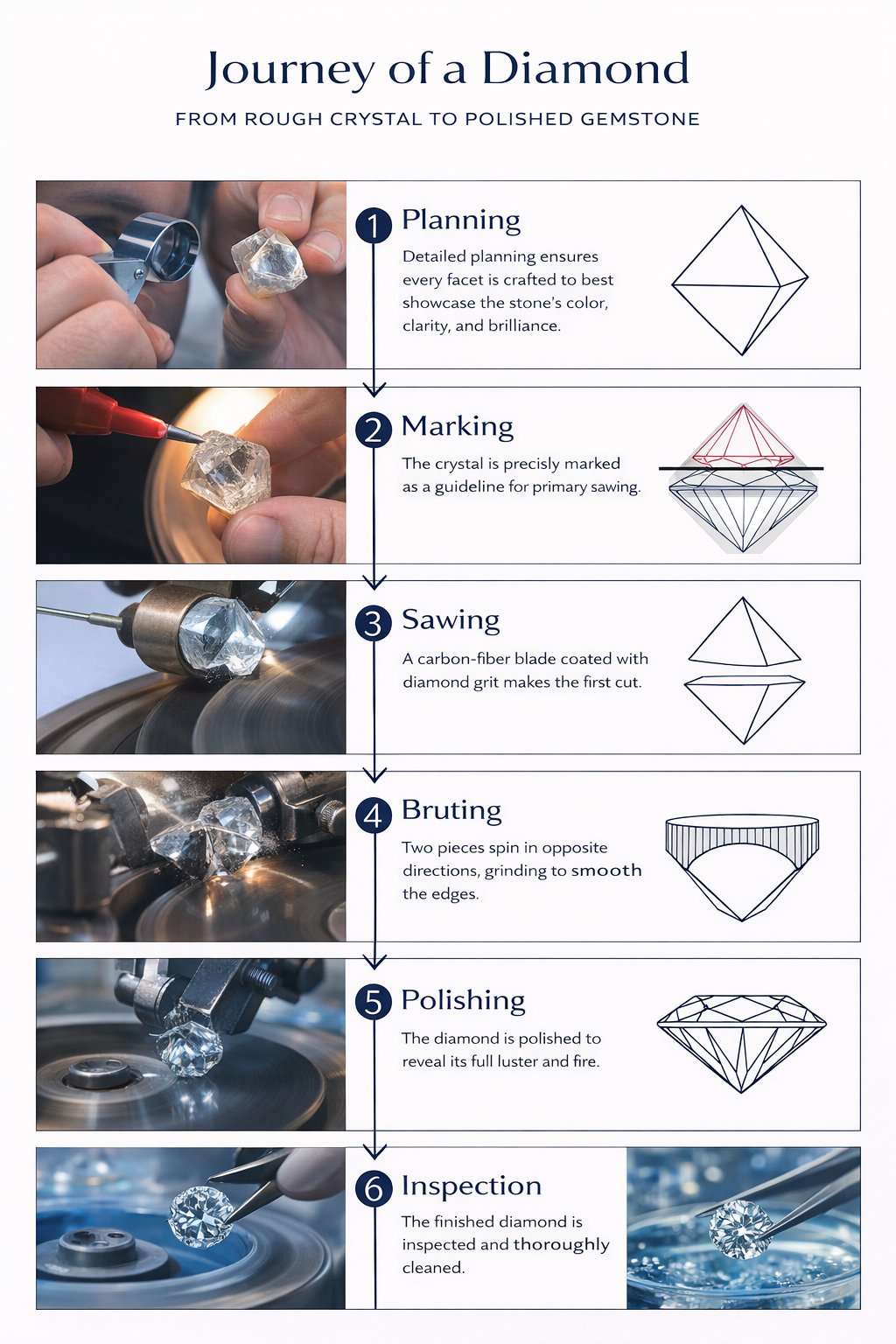
A rough diamond crystal bears almost no resemblance to the gleaming jewel it becomes. The transformation from earth to elegance is a meticulous sequence of skill, expertise, and patience — a craft that has been refined over centuries.
Every rough diamond crystal is studied under magnification by a skilled planner who maps its internal growth directions, inclusions, and natural shape. This blueprint determines how the stone should be oriented for cutting to maximise its beauty and value. A single planning decision can mean the difference between one exceptional diamond and two good ones.
Once the plan is finalised, the rough crystal is marked precisely for primary sawing. Marks guide the cutters to minimise waste while preserving the stone's most desirable qualities. This is a thoughtful process that respects the original integrity of the natural stone while envisioning its ultimate form.
Using a diamond-tipped saw or, increasingly, precision lasers, the rough stone is divided along its planned lines. A single crystal may take several hours to saw into two pieces, each destined to become a separate polished diamond. This stage demonstrates the extraordinary care required to transform a rough natural diamond into an elegant gemstone.
Two diamond pieces are spun in opposite directions against each other, grinding away material to create a round outline. This process — also called girdling — shapes the symmetry of the stone and is the key step that gives a round brilliant its defining circular silhouette. Only diamond can be used to shape diamond.
The most critical stage. Each facet is individually ground and polished on a spinning wheel coated with diamond grit, rotating at 3,000 to 5,000 RPM. This is where the diamond's final character emerges — each polished facet contributing to how the finished stone captures and returns light. A master polisher may spend hours on a single stone.
Once complete, the diamond is boiled in acid to remove all polishing residue, then examined against strict quality criteria. Stones destined for certification are sent to an independent laboratory such as GIA or IGI, where graduate gemologists evaluate the 4 C's under standardised conditions and issue the grading report that accompanies the diamond for life.
Every part of a diamond has a name, a function, and a direct relationship to how it performs in light. Understanding a diamond's anatomy helps you understand why cut quality is the single most powerful determinant of beauty.
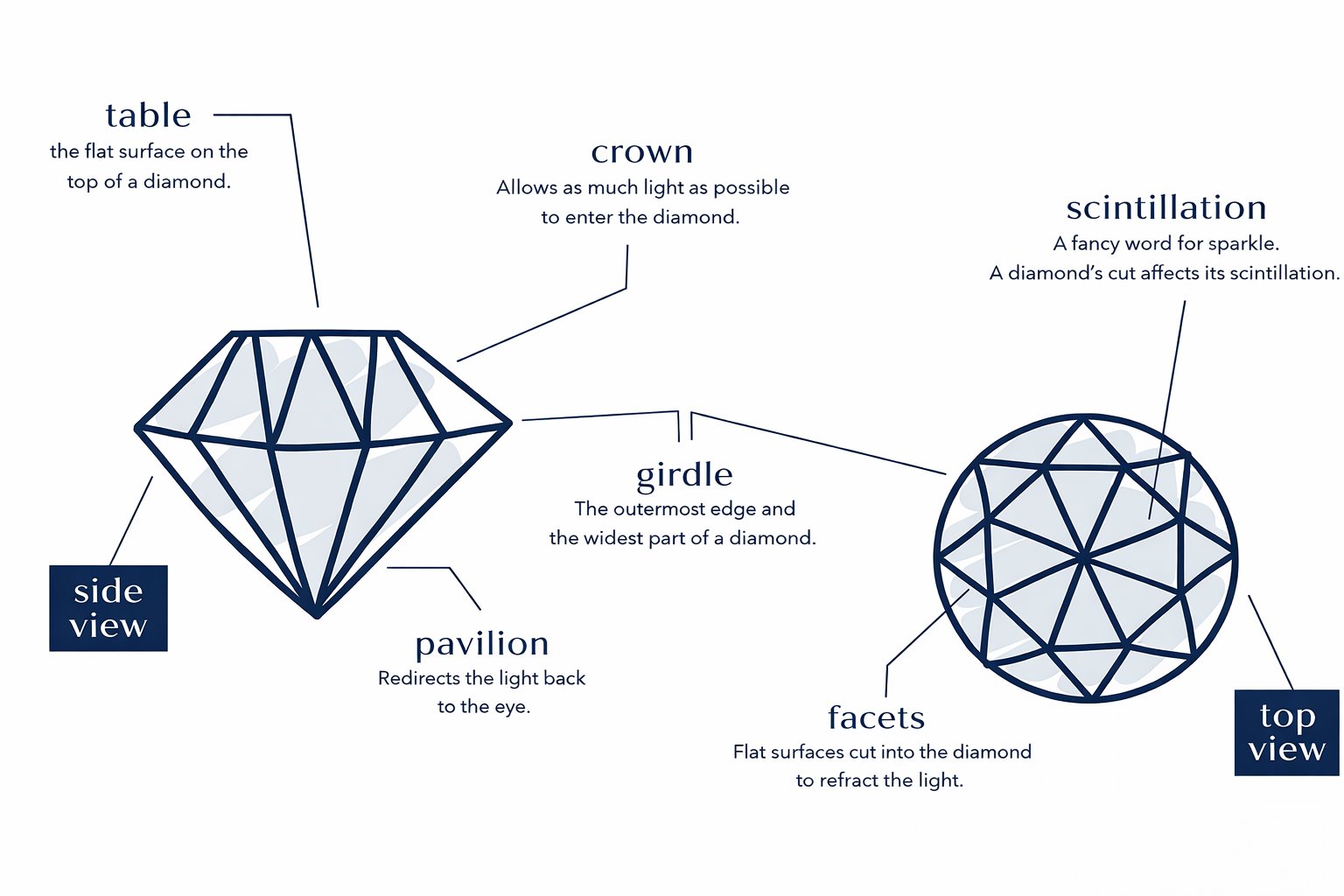
The largest flat facet on the very top of the diamond. Light enters primarily through the table. Its size as a percentage of the diamond's total width is recorded on every grading certificate and influences how a diamond handles incoming light.
The upper portion of the diamond above the girdle. The crown's primary role is to gather and bend incoming light, directing it downward into the pavilion for internal reflection. Crown angle directly influences fire — the dispersion of white light into colour.
The outermost edge of the diamond and its widest point. The girdle separates crown from pavilion and provides the primary surface for securing a diamond in its setting. The GIA laser-inscribes certificate numbers onto the girdle of most certified diamonds.
The lower, tapered half of the diamond below the girdle. The pavilion's angled facets act as mirrors, bouncing light back upward through the crown and out through the table. Pavilion depth is one of the most critical determinants of brilliance.
The precisely angled flat surfaces cut and polished onto a diamond. A standard round brilliant has 58 facets. Each facet is an optically flat plane designed to reflect and refract light at a specific angle, contributing to the diamond's overall brightness, fire, and scintillation.
The very bottom point of the pavilion. In modern round brilliants, the culet is typically a single point or extremely small facet. A well-cut culet is invisible when viewing a diamond face-up and should not disrupt the light pattern within the stone.
A natural diamond's value is not merely a matter of perception or marketing. It is the result of genuine geological scarcity, centuries of cultural significance, and an irreversible supply constraint that no technological development can overcome.
For every one million rough diamonds mined, only a small proportion yield a polished gem of meaningful quality and size. The geological processes that formed natural diamonds ceased billions of years ago — the earth is not making more. Every diamond mined brings the finite supply slightly closer to its limit.
Market demand and rarity together determine a natural diamond's price, alongside the 4 C's. Provenance — the documented origin of a stone from a specific mine — can add meaningfully to value, particularly for exceptional stones from historic deposits such as the now-closed Argyle mine in Western Australia or the legendary Golconda mines of India.
Historically, natural diamonds have held and slowly appreciated in value over the long term — a reflection of their scarcity, their association with luxury, and the enduring human desire to own something irreplaceable. For significant stones, a certified grading report from an independent laboratory is the most reliable record of value for insurance, resale, and inheritance purposes.
The Rarity Pyramid — Natural Diamond Quality
A Flawless, D-colour diamond of significant carat weight represents a literal one-in-millions natural occurrence — which is reflected directly in its market value.
Of every one million rough diamonds retrieved from the earth, only a small fraction yield a polished gem of meaningful clarity, colour, and size. The rest are industrial diamonds used in cutting and drilling applications.
On average, approximately 250 tons of ore must be mined and processed to yield a single one-carat polished diamond of gem quality. This physical reality underpins the material value of every natural diamond.
The geological conditions that created natural diamonds no longer exist. The earth's supply is both fixed and diminishing. As accessible deposits are exhausted, natural diamonds of exceptional quality become progressively rarer and more valuable.
The internationally recognised system for evaluating a natural diamond's quality is built on four criteria, developed by the Gemological Institute of America in the 1940s and adopted as the global standard. Together they provide a complete picture of a diamond's character and value.
Proportions, symmetry, and polish determine how light performs within the stone. Cut is the primary driver of brilliance, fire, and scintillation.
Measures the absence of colour. D is completely colourless and the rarest. Most buyers find G-H offers the best balance of quality and value.
Evaluates internal inclusions and surface blemishes under 10x magnification. VS1-VS2 offers eye-clean perfection with excellent value.
1 carat equals 0.2 grams. Price rises sharply at round number thresholds — buying just below magic weights (0.90ct vs 1.00ct) saves significantly.
The most important questions about natural diamonds, answered clearly and completely.
Natural diamonds formed between one and three billion years ago, deep within the earth's mantle under extreme heat (1,000–1,300°C) and pressure (45+ kilobars). Carbon atoms crystallised under these conditions into the diamond cubic lattice. Ancient volcanic eruptions of kimberlite magma then carried finished diamonds rapidly to the surface through pipe-like channels, where they now exist about 100–200 kilometres beneath the surface, waiting to be mined.
Price is primarily determined by the 4 C's — carat weight, colour, clarity, and cut. Beyond these, market demand, rarity for specific characteristics (such as exceptional size or unusual colour), and provenance from historically significant mining regions all contribute. A GIA grading certificate provides the objective quality record that anchors a diamond's fair market value.
Yes — genuinely and materially rare. The geological conditions that formed natural diamonds no longer exist on Earth. Of the rough diamonds retrieved from the ground, only a small fraction are of gem quality. For large, high-quality stones, rarity increases dramatically — a truly Flawless, D-colour diamond above 3 carats is an extraordinary natural occurrence.
Authentication is achieved through professional gemological evaluation. A certificate from an independent laboratory such as GIA or IGI provides the most reliable verification, including confirmation of natural origin. The GIA laser-inscribes a certificate number on the girdle of most certified diamonds, allowing identity to be verified at any time. For uncertified diamonds, professional gemological testing — including thermal conductivity, refractive index, and spectroscopic analysis — can confirm natural diamond origin.
A diamond's sparkle is the product of three optical phenomena working together: brilliance (white light reflected from the interior back to the eye), fire (white light dispersed into spectral colours), and scintillation (the dynamic play of light and shadow as the stone, light source, or observer moves). All three are determined primarily by cut quality — the proportions, symmetry, and polish of the finished stone — which is why cut is considered the most important of the 4 C's.
Natural diamonds have historically held and slowly appreciated in value over the long term, driven by genuine scarcity, sustained global demand, and timeless cultural significance. However, their value as an investment is a long-term proposition — it typically takes considerable time for secondary market prices to exceed what was paid at retail. The more immediate and certain value of a natural diamond is personal and emotional: as the physical embodiment of a milestone, a commitment, or a legacy passed from one generation to the next.
Diamond. It scores 10 on the Mohs hardness scale — the maximum possible rating — and is approximately 140 times harder than corundum (sapphire and ruby), which ranks 9. This extreme hardness means a natural diamond will retain its polish and brilliance indefinitely. It also means only a diamond can be used to cut and polish another diamond — which is why diamond grit is the universal abrasive in precision lapidary work.
Natural diamonds are the hardest substance on Earth, but their settings require mindful care. Clean regularly with warm water, mild soap, and a soft brush. Avoid harsh chemicals and store each piece separately to prevent scratching. For more information on caring for your natural diamond and jewellery, view our Jewellery Care Guide.
“Your diamond is exceptional and distinctive. No two diamonds are alike. And the story of your diamond — formed over a billion years, carried by the earth's own forces, cut and polished by the most skilled hands — is uniquely yours.”
Jhunjhunwala Diamonds · Diamond Education